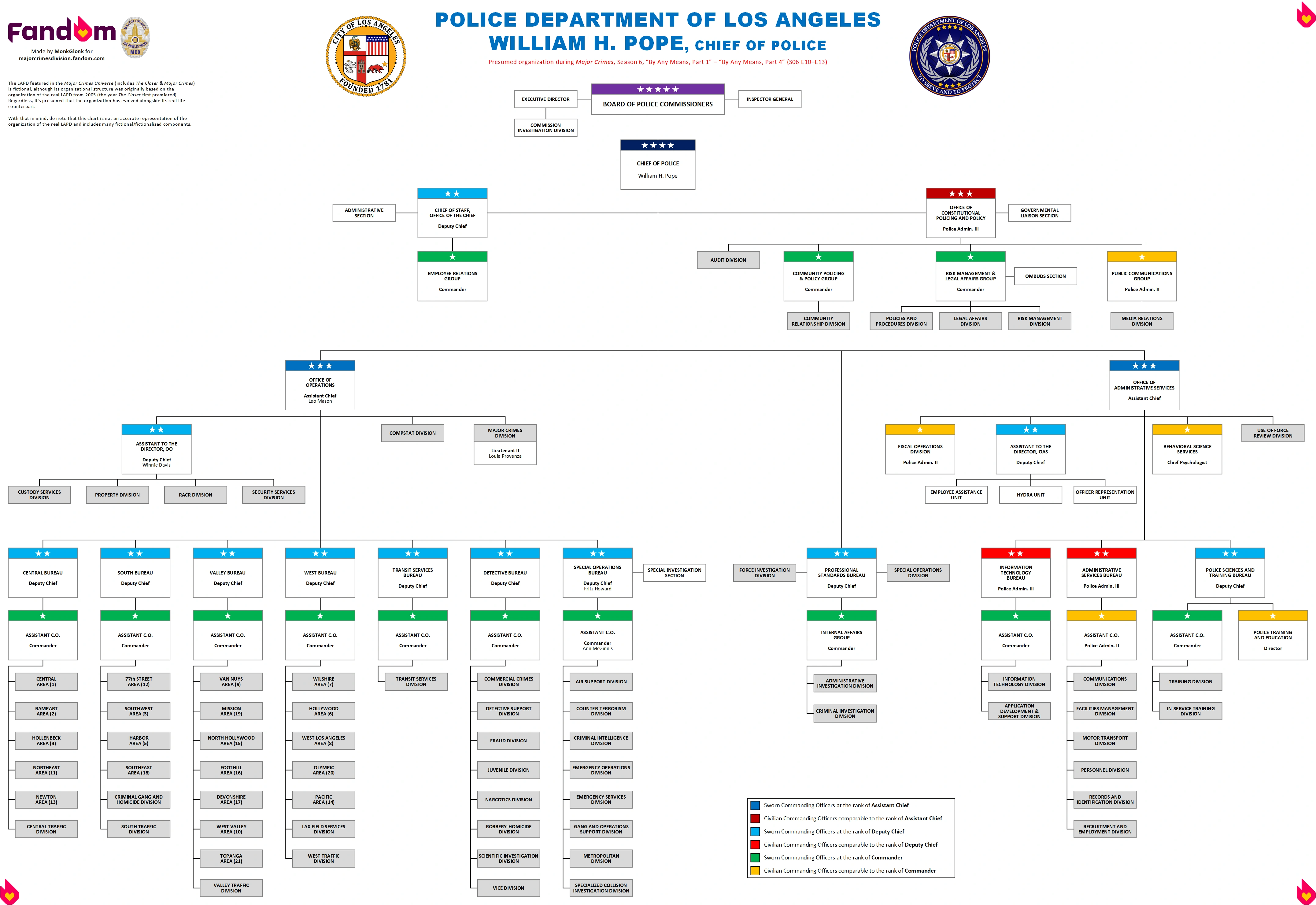
| NOTE: The Los Angeles Police Department (LAPD) featured in the Major Crimes Universe is fictional but it's loosely based on the organization of the real LAPD from 2005, the year The Closer premiered. This article about the Special Operations Bureau is fiction, as the way it's depicted in the Major Crimes Universe differs from its real world counterpart. |
The Special Operations Bureau (SOB) provides the Los Angeles Police Department (LAPD) specialized uniformed and tactical resources in support of daily field activities, unusual occurrences, and during serious disturbances and elevated threat conditions.
SOB also provides line supervision over all of the department's gang and narcotics enforcement strategies as well as geographical area Gang Impact Teams. The mission is to establish collaborative, consistent and coordinated approach to abating criminal gang activity and narcotics trafficking with an emphasis on enforcement, intelligence gathering, investigation, prosecution, intervention, and prevention.
Headquarters[]
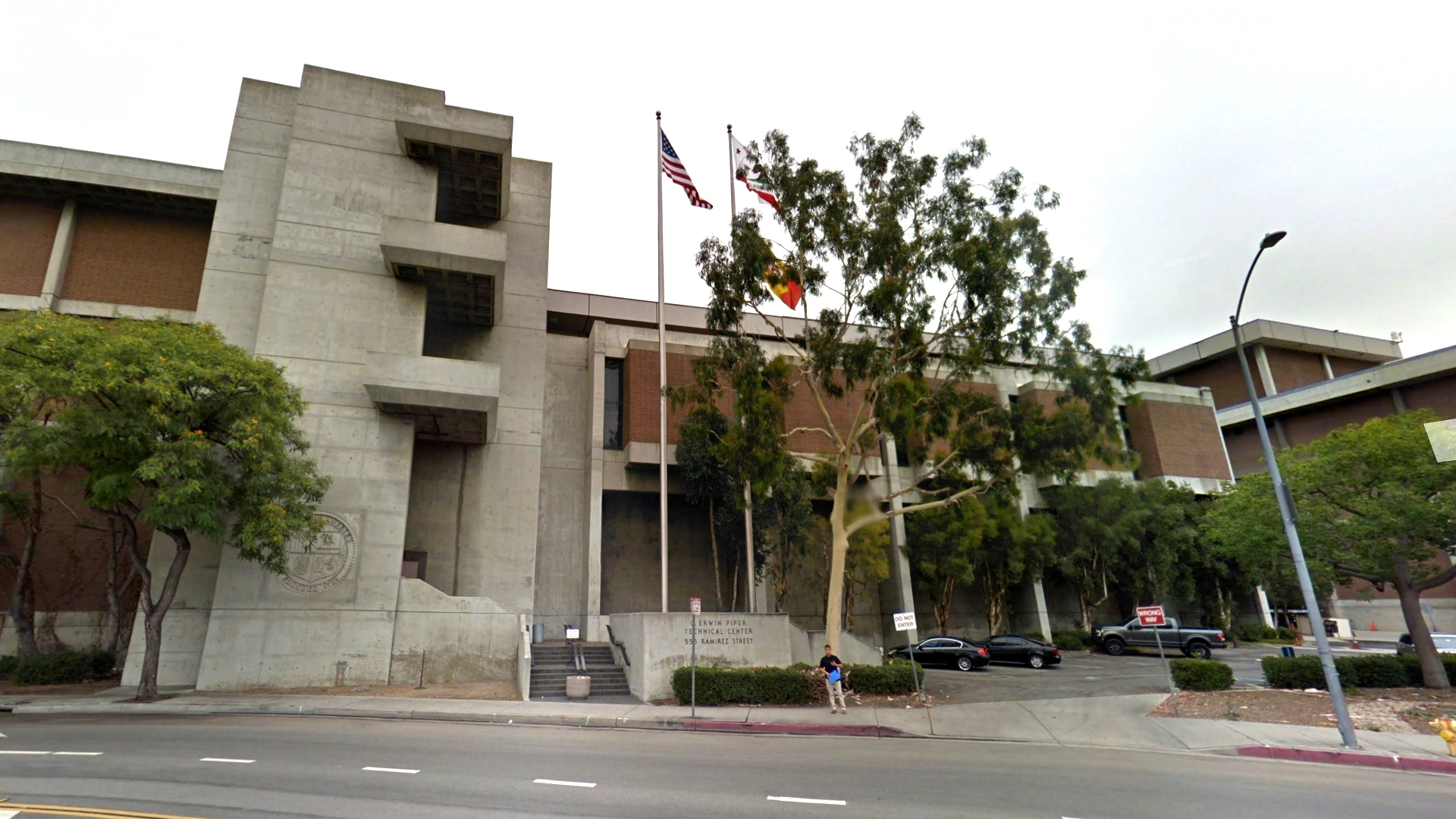

Piper Tech
The main offices of SOB are located in the C. Erwin Piper Technical Center, Piper Tech for short, in downtown Los Angeles, next to Union Station and about one mile away from LAPD Headquarters.
Other SOB components that are confirmed to be located at Piper Tech are the Special Investigation Section and the Air Support Division. Excluding the Metropolitan Division, which has its own dedicated facility, it's possible that the other components of SOB are also located at Piper Tech, though this was never confirmed in the show(s).
- NOTE: In the real LAPD, SOB's headquarters has never been located at Piper Tech. It was originally located at the Parker Center, later moving to the new Police Administration Building when it opened in 2009.
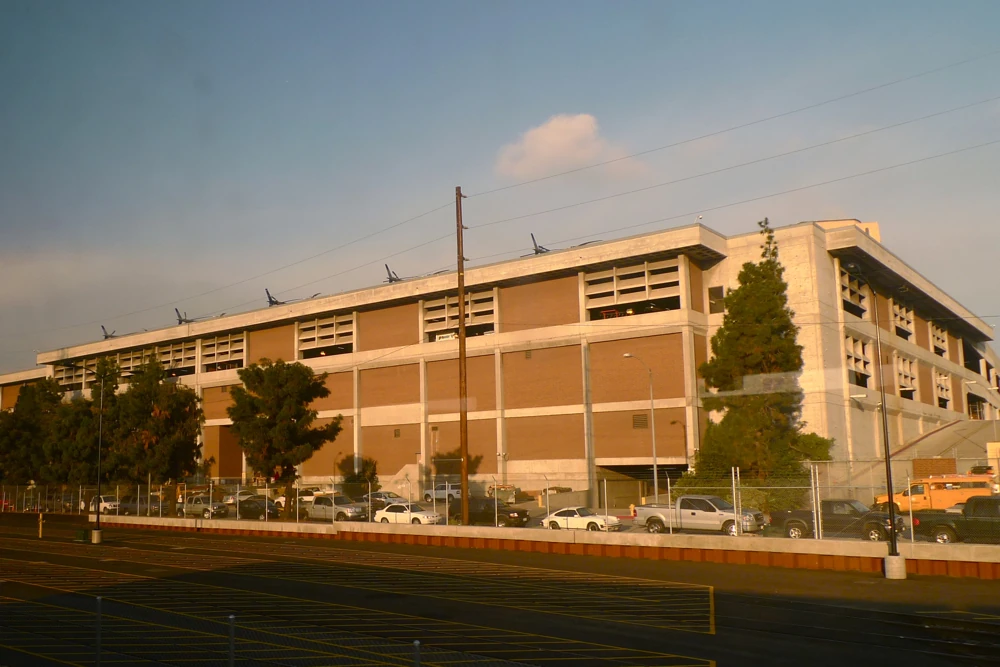

Back of Piper Tech
Some components of the Office of Support Services are also located at Piper Tech, including parts of the Scientific Investigation Division (Technical Laboratory), Fiscal Operations Division (Supply Section), Motor Transport Division (Central Garage), and the Property Division (Evidence Control Section).
The Records and Management Division of the Los Angeles Office of the City Clerk is also located at Piper Tech.
Command staff[]
Commanding Officer[]
The Commanding Officer is responsible for managing, supervising, and coordinating the specialized tactical resources of the LAPD. As a staff officer, they are also responsible for developing and recommending policies and procedures affecting those functions under their command.
By position, the Commanding Officer is also assigned some specialized duties:
- Permanent member, K-9 Bite Review Board — responsible for reviewing incidents in which a member of the public is bitten by a LAPD canine wherein hospitalization is required. The review board shall evaluate the propriety of the incident as well as the associated policy, training, risk management, and disciplinary issues.
- Rotating member, Operations Communications Committee — responsible for developing communications procedures affecting both the Office of Operations and Communications Division. The Committee shall not establish policy, but instead meet as needed to develop procedures based on existing policy.
- Department Gang Coordinator — responsible for developing policies and procedures for gang and narcotics enforcement strategies as well as providing citywide oversight of geographical area Gang Impact Teams and geographical bureau Gang Coordinators. This includes the scheduling of Bureau Gang Coordinator audits, development of audit methodology, and the review of audit findings.
- Department Traffic Coordinator — responsible for coordinating the review of the department's Fleet Safety Program to assure equitable classifications and disciplinary actions; reviewing all completed Fleet Safety Report packages to determine compliance with department procedure and consistency of the final classification; providing the Assistant Chief of Support Services with information that will facilitate driver-training needs; and approving requests for the appearance of the Motorcycle Drill Team.
- Department Dignitary Security Coordinator — responsible for coordinating the use of protective details for select city officials, including the Mayor and Chief of Police, and other dignitaries, as needed.
- The Commanding Officer may approve a request from the Commanding Officer, Metropolitan Division, for the use of explosives during an entry by the Special Weapons and Tactics Team as well as other extraordinary methods utilized to protect public safety.
|
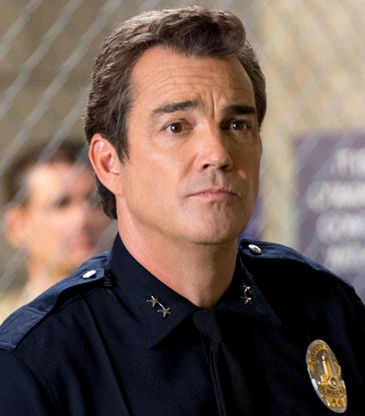
Deputy Chief Fritz Howard is currently the Commanding Officer of the Special Operations Bureau. Chief Howard was assigned as the Commanding Officer at the end of “Sweet Revenge” of Major Crimes, Season 3. This is also the same time he was hired by the LAPD and appointed as a Deputy Chief, having previously been employed by the Federal Bureau of Investigation. |
Based on episode dialogue, the position was left vacant by the beginning of Major Crimes, Season 3, for unknown reasons. It is not currently known who was the Commanding Officer during The Closer or Major Crimes, Seasons 1 and 2.
Assistant Commanding Officer[]
The Assistant Commanding Officer assists the Deputy Chief in coordinating the bureau's activities and will act as the Commanding Officer during the Chief's absence. As a staff officer, they are also responsible for developing and recommending policies and procedures affecting those functions under their command.
|
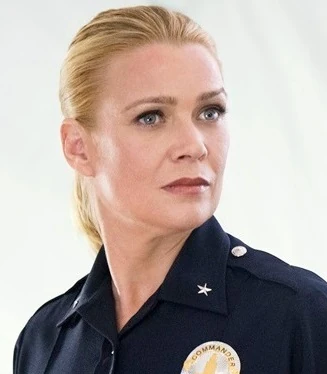
Commander Ann McGinnis is currently the Assistant Commanding Officer of the Special Operations Bureau. Based on episode dialogue, McGinnis has been the Assistant Commanding Officer for the entire duration of Major Crimes. Between the events of “Flight Risk” and “Sweet Revenge”, Cmdr. McGinnis was the Acting Commanding Officer after the post was left vacant by the previous Commanding Officer. McGinnis assumed the role of Acting Commanding Officer once again in “White Lies, Part 1” after Deputy Chief Howard was assigned as the Acting Assistant Chief of Operations. She remained in command until the end of “Shockwave, Part 2” when Chief Howard returned to SOB. |
Subordinate components[]
Special Investigation Section[]
The Special Investigation Section (SIS) is the tactical surveillance unit of the LAPD. Its primary mission is to determine if the suspects under surveillance are connected to the crimes under investigation, and, if needed, to locate and arrest the suspects.
Air Support Division[]
The Air Support Division (ASD) is the LAPD's airborne unit and the largest municipal airborne unit in the United States, consisting of 88 sworn personnel and 19 helicopters.
Metropolitan Division[]
The Metropolitan Division (Metro) provides support to the department’s community-based policing efforts by deploying additional crime suppression resources throughout the City. These assignments include uniformed crime suppression details, as well as responding to high-risk barricaded situations, stakeouts, security details, and warrant service.
Special Operations Support Division[]
The Special Operations Support Division (SOSD) is responsible for providing administrative and investigative support, expertise, and training on matters relating to gangs and traffic issues.
Specialized Collision Investigation Division[]
The Specialized Collision Investigation Division (SCID) responds to complicated collision scenes throughout the entire Los Angeles area, and completes traffic collision reconstructions for traffic division detectives and the District and City Attorney's offices.
Proposed SOB spin-off[]
During Major Crimes, Seasons 3 and 4, there was a possibility that SOB was going to be getting it's own show. While SOB was not officially piloted, the characters that would have appeared in the spin-off were introduced in the Season 3 episode “Two Options”.
Some of the old (and new) cast the new show would have featured would have been Jon Tenney as SOB Commanding Officer Deputy Chief Fritz Howard, Laurie Holden as SOB Assistant Commanding Officer Commander Ann McGinnis, and Malcolm-Jamal Warner as SIS Officer-in-Charge Lt. Chuck Cooper. Hampton Fluker and Brock Harris, who were introduced in “Two Options”, would have also returned as SWAT officers Jamey Perez and Chad Stuart, respectively.
The spin-off had been proposed under Michael Wright, the President of TNT & TBS and Chief Creative Officer of Turner Broadcasting, but after he was replaced by Kevin Reilly, the proposal was scrapped.
| MAIN ARTICLE: LAPD | Organizational chart (.PDF version) |
Ranks of the Los Angeles Police Department | Awards of the Los Angeles Police Department | Police Administration Building | |
|---|---|---|---|---|---|
| Office of the Chief of Police | Professional Standards Bureau: Force Investigation Division |
Counter-Terrorism Bureau | |||
| Office of Operations | Major Crimes Division | Criminal Intelligence Division | |||
| Special Operations Bureau: SIS • ASD • Metro • SOSD • SCID |
Detective Bureau: CCD • DSD • JUV • ND • RHD • VD | ||||
| Other units | Office of Support Services: Scientific Investigation Division |
Office of Constitutional Policing and Policy | |||